Cradlecrown v2.2: Europe
Two new regions, twenty-six new civilizations. From the Hallstatt Celts to Castile and from the Nordic Bronze Age to the Kalmar Union, each has its own soldiers, its own buildings, its own masterpiece and its own rule.
The biggest gap on Cradlecrown’s map was Europe. There was Mesopotamia, the Nile, India, China and the Aegean, and nothing beyond the Rhine, the Danube or the Baltic. v2.2 adds two regions and twenty-six civilizations. The game now has 91 civilizations and seven starting points.
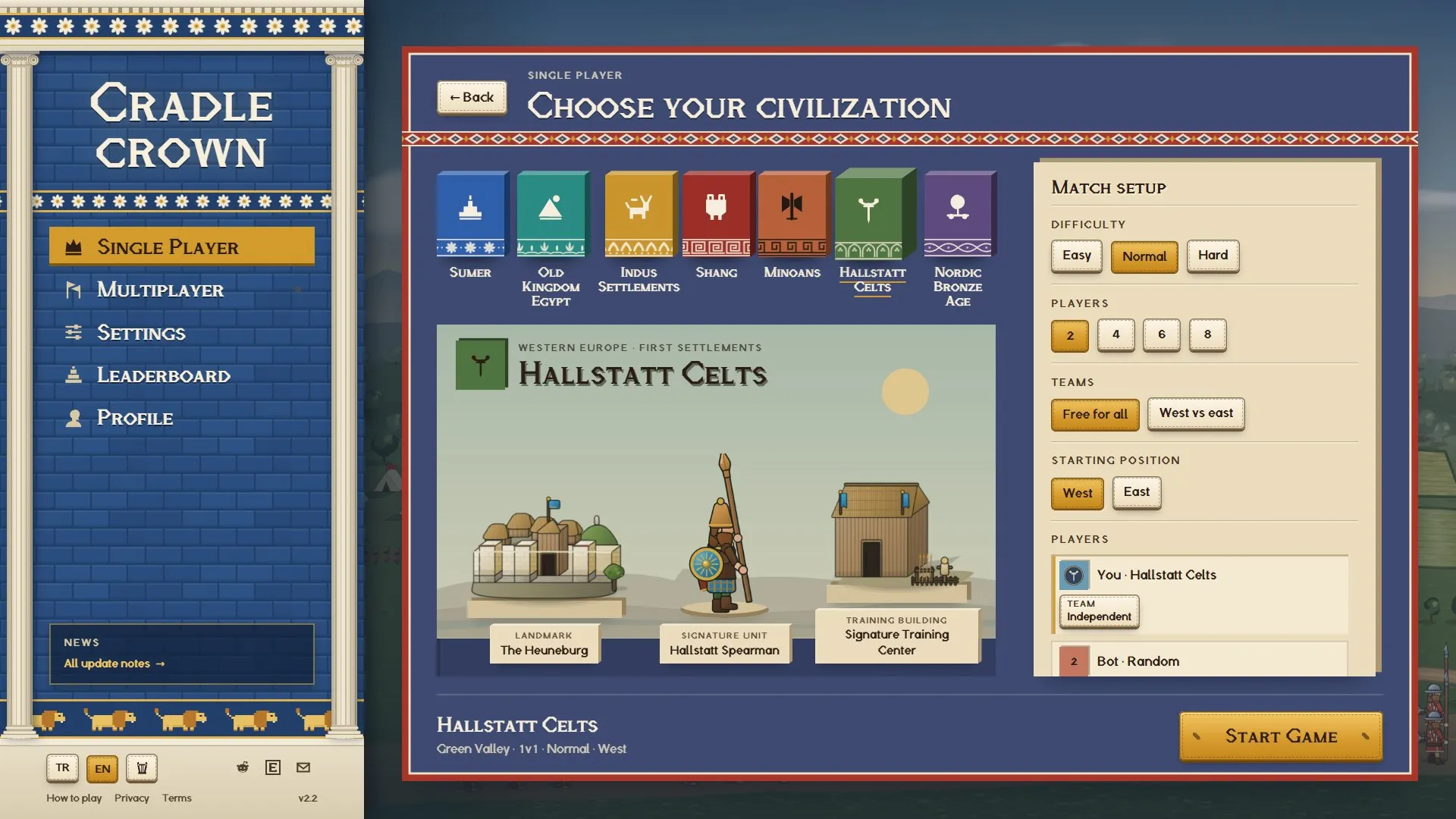
Two regions
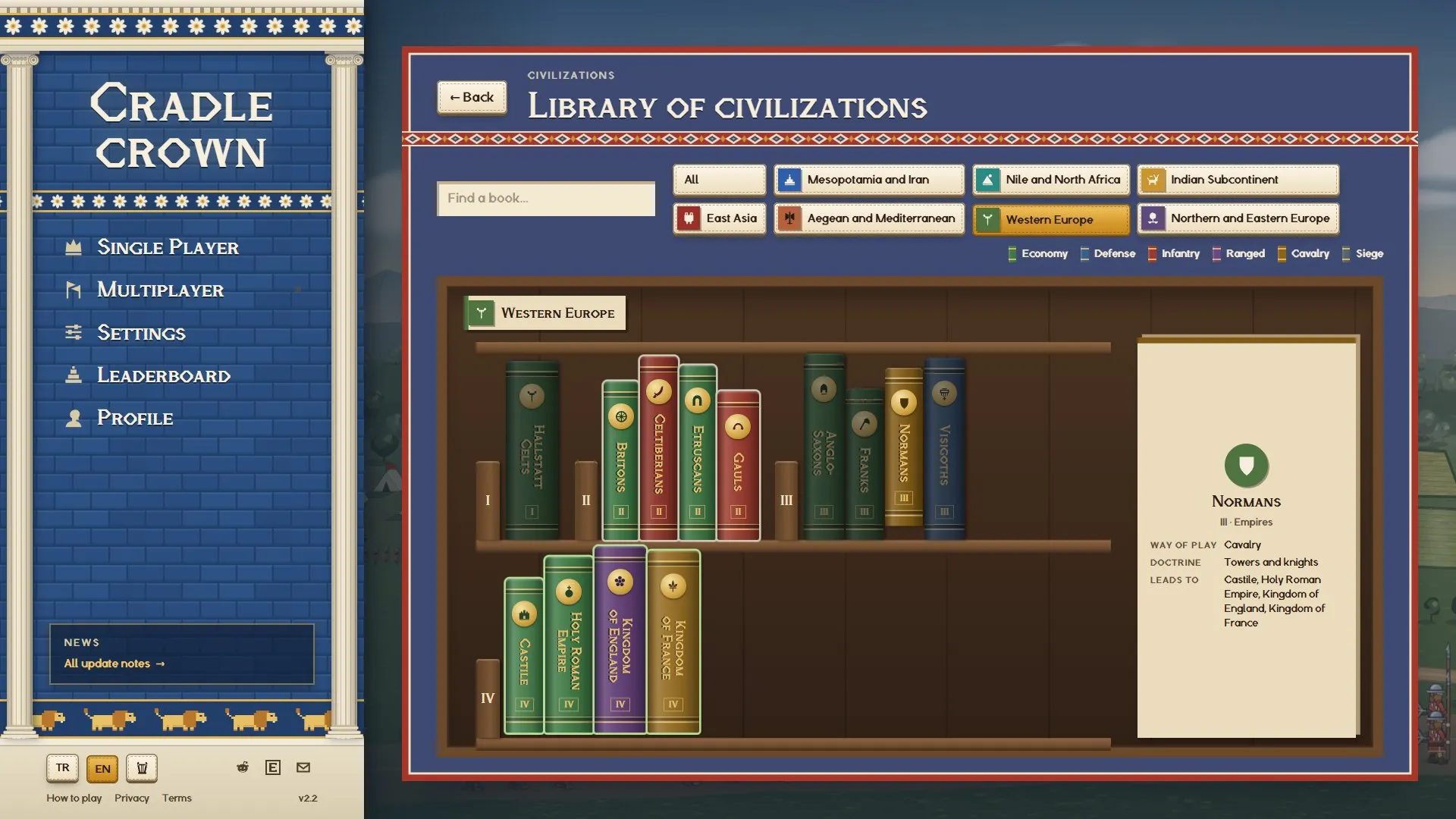
Western Europe begins with the Hallstatt Celts. The second age brings the Gauls, Britons, Celtiberians and Etruscans; the third the Franks, Visigoths, Anglo-Saxons and Normans; the fourth the kingdoms of France and England, Castile and the Holy Roman Empire.
Northern and Eastern Europe begins with the Nordic Bronze Age. Then come the Germanic tribes, Dacians, Thracians and Scythians; the Vikings, Kievan Rus’, Magyars and the First Bulgarian Empire; and at the end Poland-Lithuania, Muscovy, the Teutonic Order and the Kalmar Union.
I didn’t want to add these civilizations as names alone. Each has a way of play, a doctrine, three reforms, its own signature troop and a rule drawn from how that troop fought.
Signature troops
Each signature troop’s rule comes from how that soldier actually fought. A few examples:
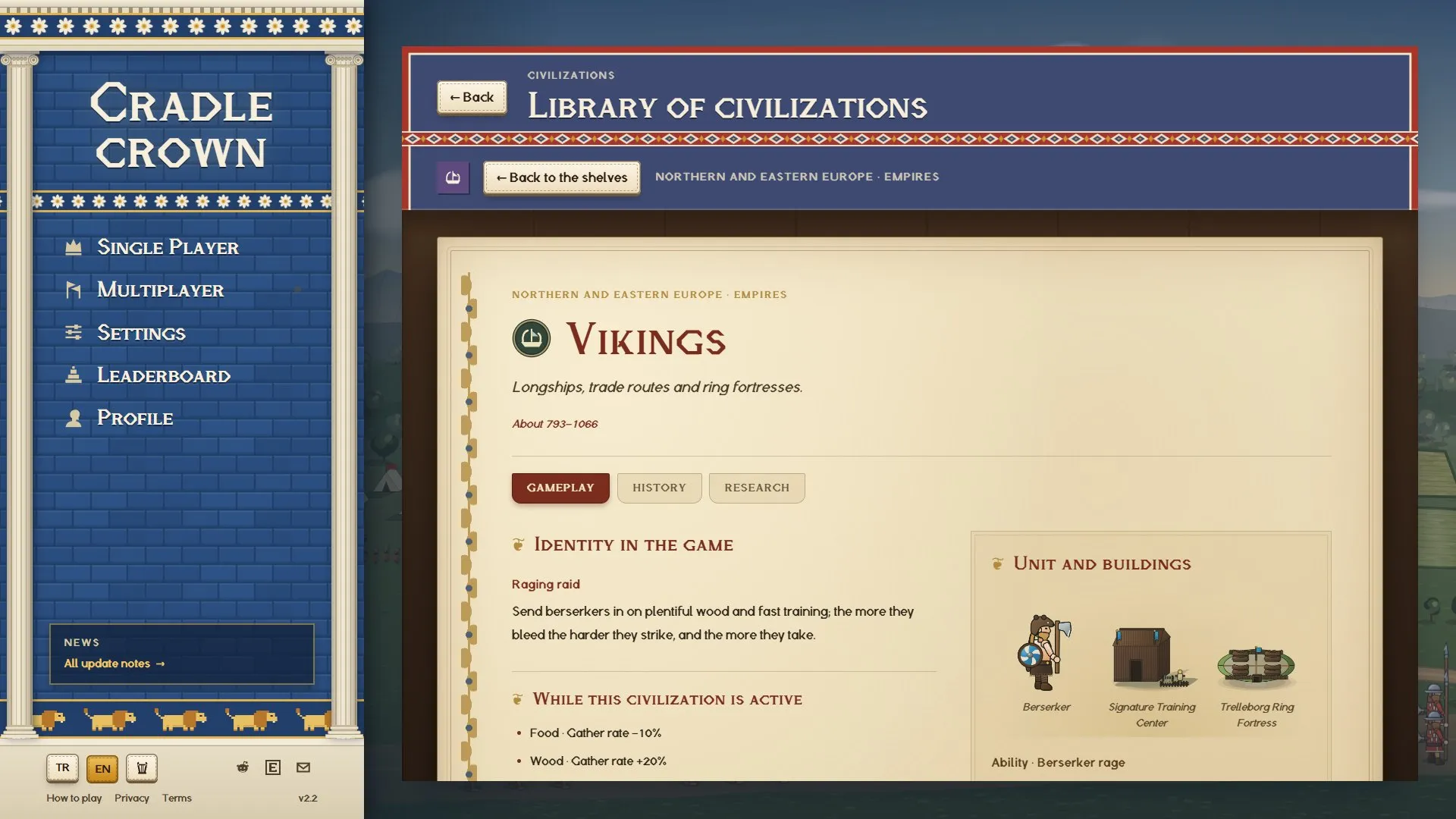
- Berserker (Vikings): below half health it deals 40% more and strikes 20% faster, but takes 8% more damage.
- Winged Hussar (Poland-Lithuania): striking after a run of at least two tiles, it slows every enemy within two tiles of the impact for 1.5 seconds.
- English Longbowman: after standing for two seconds it plants stakes. A rider who strikes it in melee takes damage and is stunned for a moment.
- Dacian Falxman: every blow splits the target’s shield, which then takes 25% more damage for four seconds.
- Scythian Horse Archer: its arrows are poisoned, and the target keeps taking damage for six seconds.
- Teutonic Knight: its plate harness takes four less damage from every blow and arrow.
- Strelets (Muscovy): fires its musket from range and meets anyone who closes in with its berdiche axe.
I tested each troop against mixed armies of equal cost and compared the results with the other troops of the same role. All of them now sit inside their role’s range; the ones that came out too strong or useless were retuned.
Soldiers
The villager, spearman, infantry, archer, cavalry and signature troop of all twenty-six civilizations are drawn by hand. The checked wool and bronze shields of Hallstatt, the long oval shields of the Gauls, the British war chariot, the painted round shields of the Vikings and their bear-pelted berserker, the tall pointed helmets of the Rus’, the hussar’s frame of feathers and leopard skin, the strelets’ long red kaftan with the berdiche on his back, the pavise of the three crowns on the Kalmar crossbowman’s back.
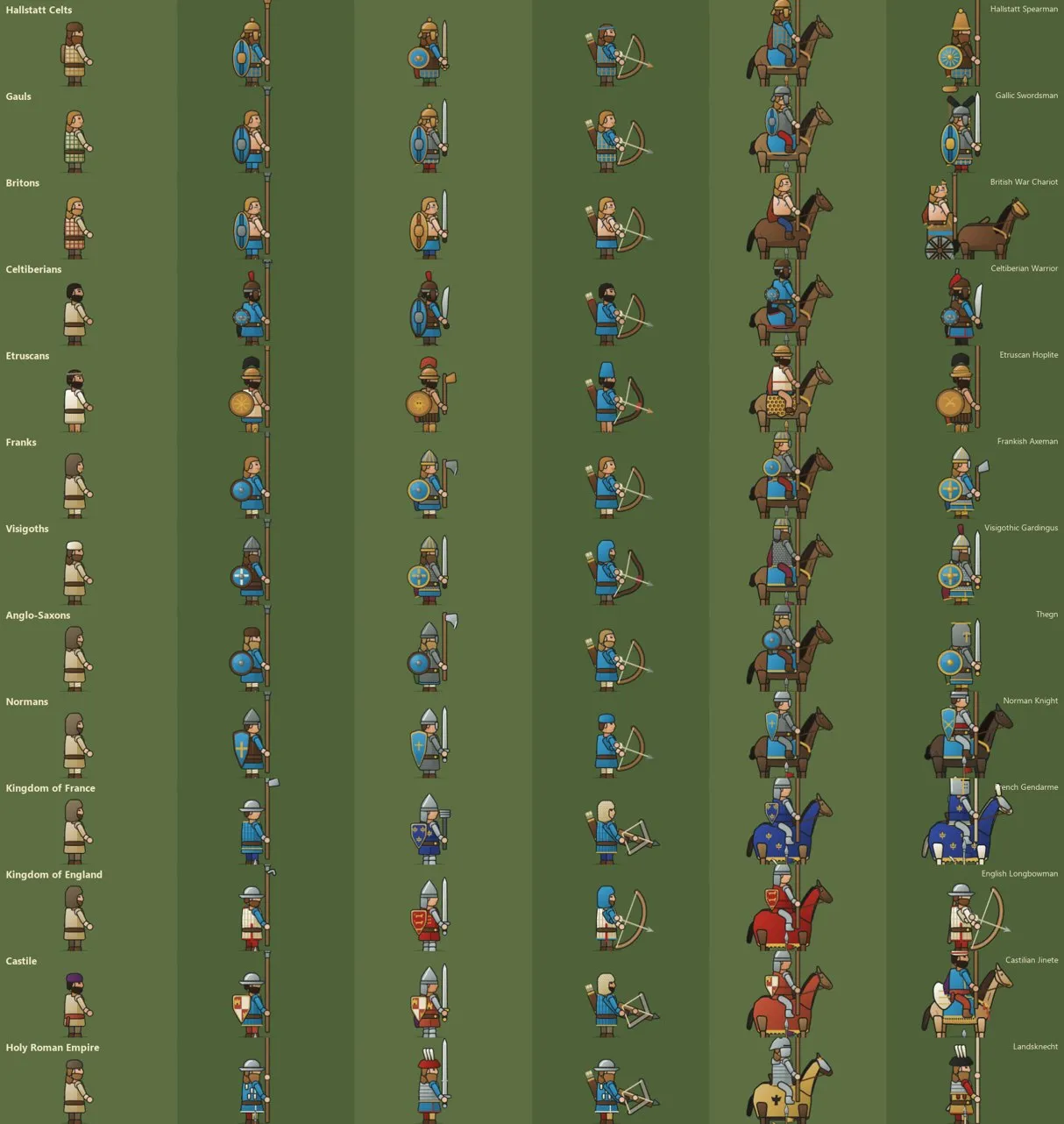
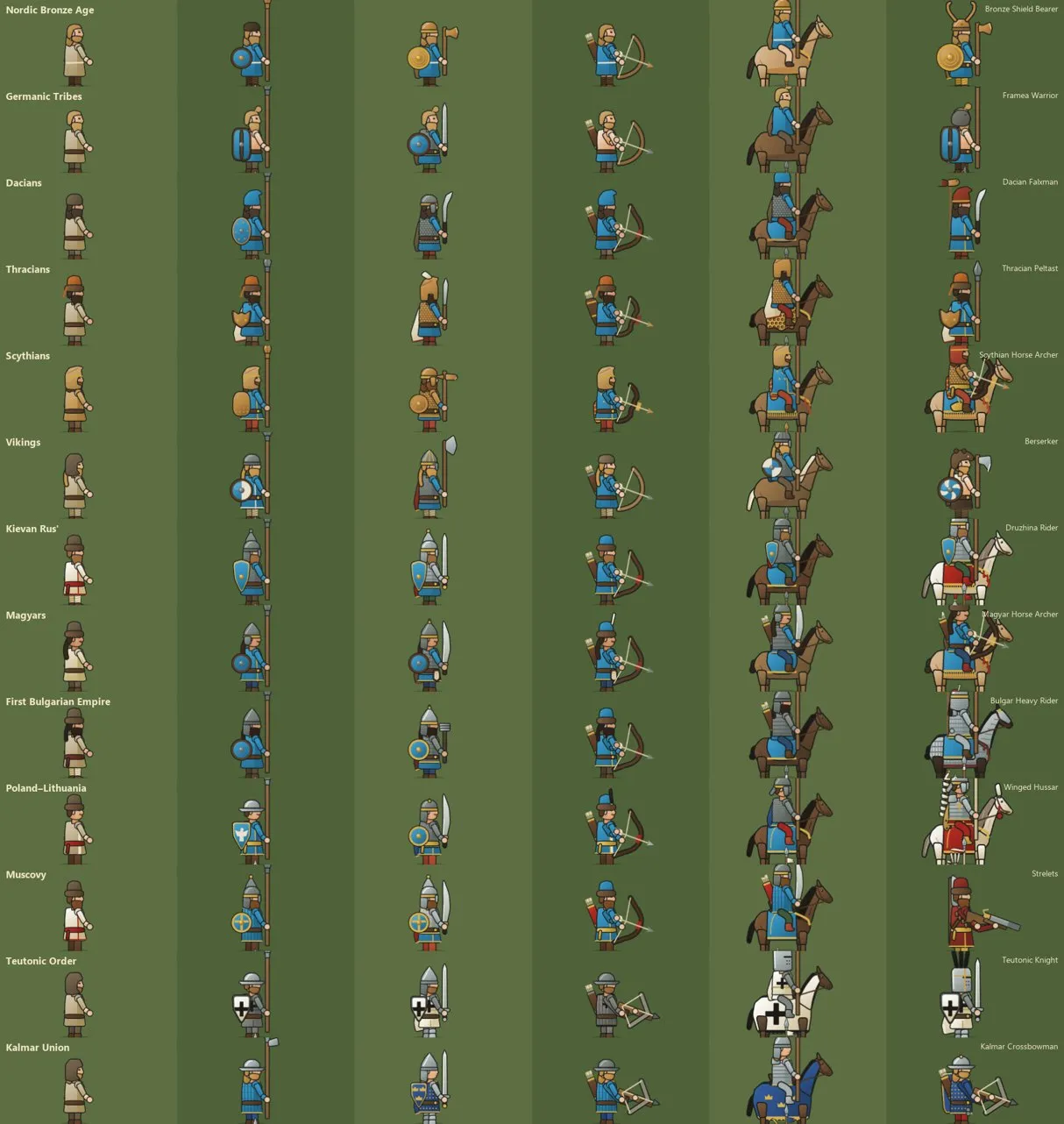
On the way I found an old bug: the arms on the shields of France, England and Castile spilled over the shield’s edge, so the shield looked like a rectangular banner. The arms now stay inside the shield.
Buildings and masterpieces
Each civilization builds in its own materials: the timber halls and thatch of Hallstatt, the round houses of the Britons, the turf-roofed longhouses of the Vikings, the log houses of the Rus’, the brick Gothic castles of the Teutonic Order, Kalmar’s round towers under copper cones. Each masterpiece is drawn after that civilization’s real monument.
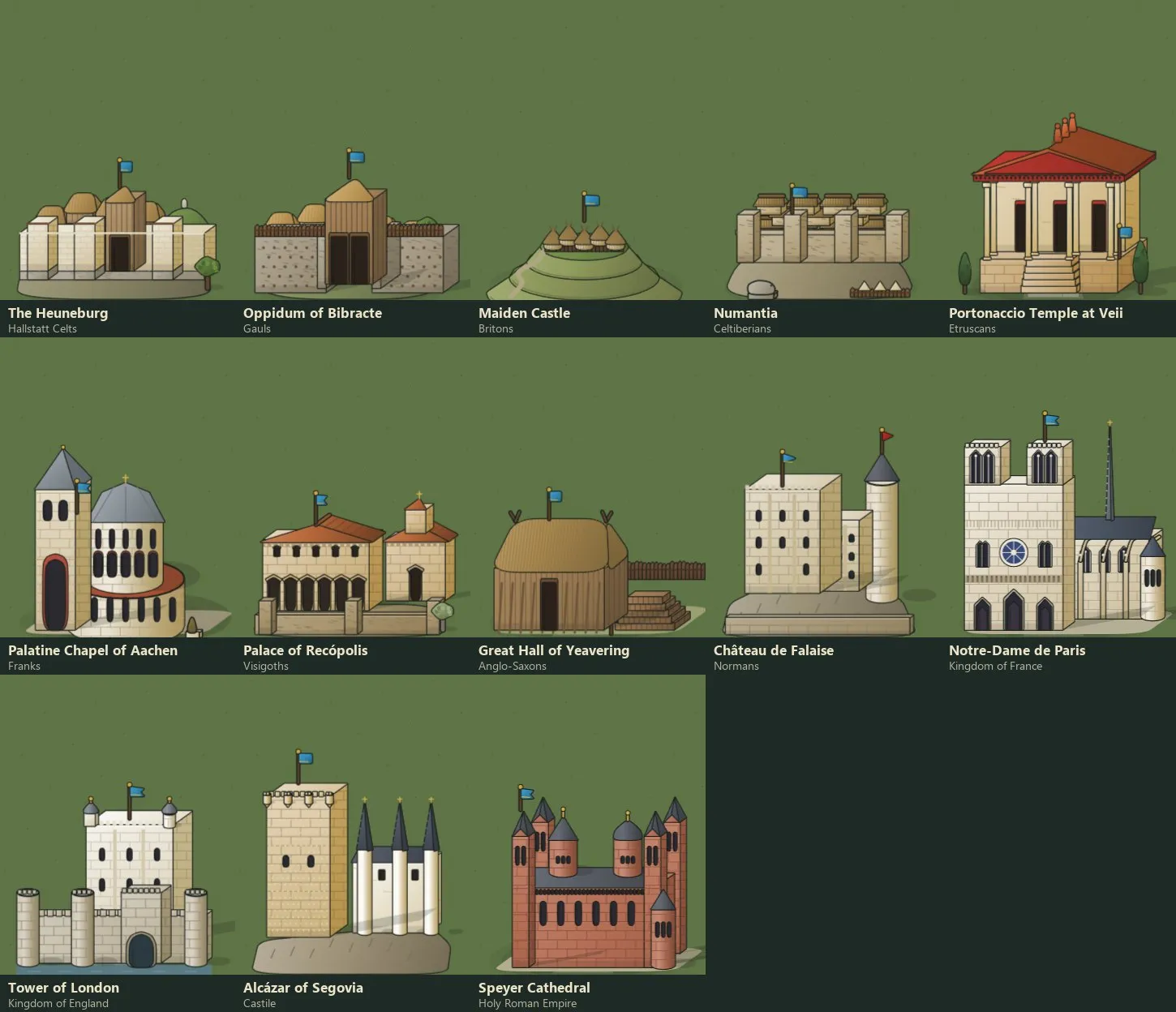
The whitewashed mudbrick wall of the Heuneburg on its stone footing, the nested earth banks of Maiden Castle, the terracotta gods striding along the roof of the temple at Veii, the octagonal chapel at Aachen, the two towers and rose window of Notre-Dame, the White Tower of the Tower of London, the rocky prow of the Alcázar of Segovia.
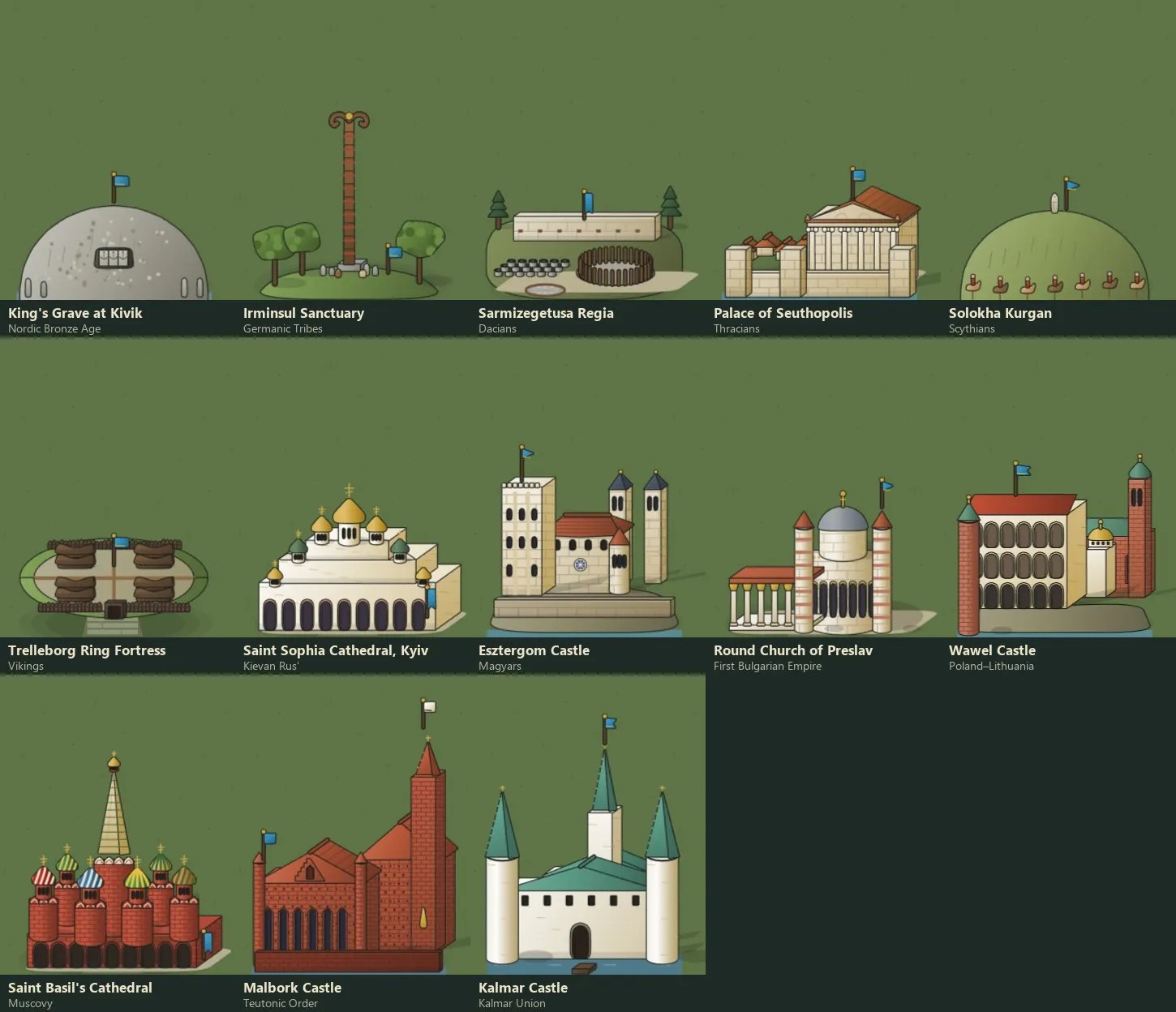
The carved burial chamber of the stone cairn at Kivik, the sun disc of Sarmizegetusa, the ring of horsemen Herodotus describes around a royal kurgan like Solokha, the perfect circle of Trelleborg, the domes of St Sophia in Kyiv, the painted onions of St Basil’s, the brick walls of Malbork.
Library and history
The library has two new shelves. Each of the twenty-six civilizations has a short history and a note on its period. Each one’s source is from UNESCO, Britannica, English Heritage or the National Museum of Denmark, and I opened and checked every link.
Interface
Both regions have their own glaze and frieze: Gothic arches on moss green in the west, and in the north two interlaced bands on heather purple, as on rune stones. They have their own skies and horizons and their own ornaments on the research seals, and they walk in the parade on the main menu.
Seven starting civilizations didn’t fit the old row of five, so I rearranged the civilization picker. I removed the region name under each tile; the region of the civilization you pick is already written above its stage. Names no longer break in the middle of a word. The region buttons in the library now sit in two rows.
Other changes
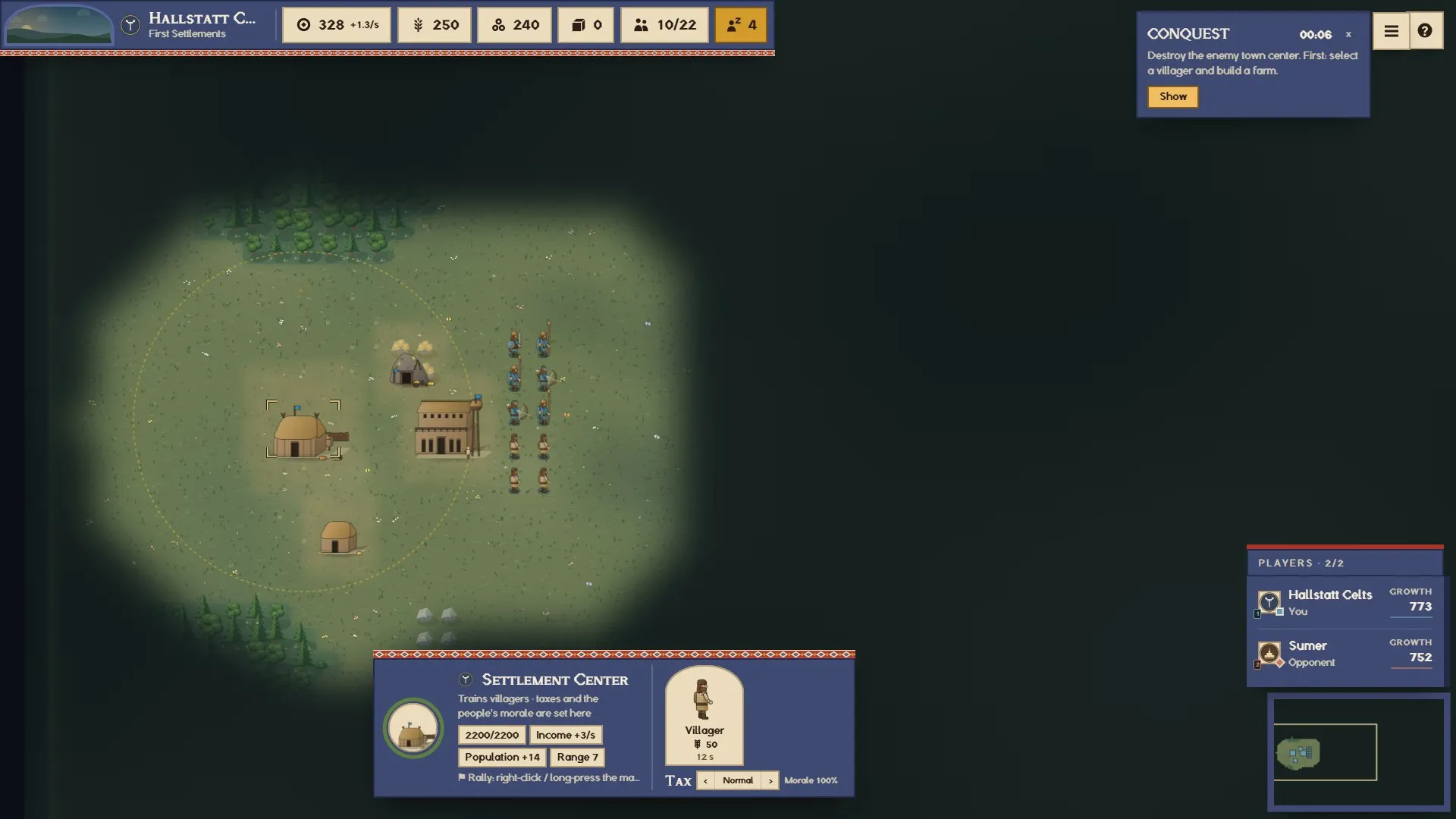
- The AI struggled to leave the first age with Hallstatt: it spent all its wood on spearmen and never built a lumber camp or its masterpiece. It now keeps wood back for them. Hallstatt reaching the next age dropped from 21 minutes to 10.
- The code the game downloads when it first opens is smaller. The menu no longer loads the combat rules; even with twenty-six civilizations added, the first download is smaller than in v2.1.
- The Frankish and Celtiberian emblems were redrawn.
- Europe plays the Aegean music for now.
This release changed the version number for online matches. If you left the game open in a tab, refresh it once before joining an online match.
The game is at cradlecrown.com. You can send bugs or suggestions through r/cradlecrown or to [email protected].